
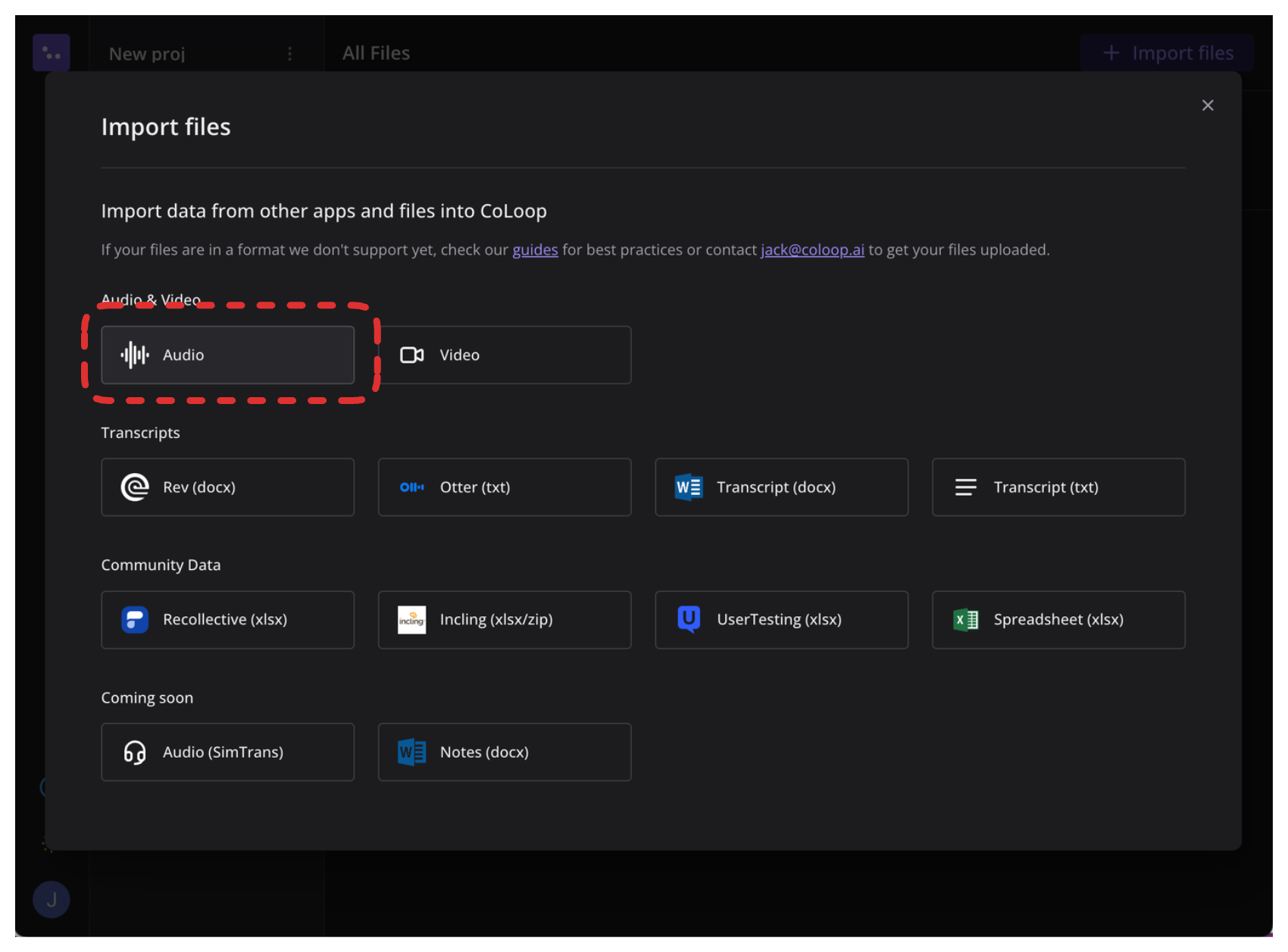
- Audio and Video
- Transcripts
- Community Data (incling, Qualzy, Recollective & Fieldnotes)
- Excel (Survey or Community Data)
Transcribe
Import audio and video
- Upload all recordings in bulk to save time. CoLoop will process them in parallel. Transcription time typically depends on file length and size, so use lower resolution video or upload audio to save time.
- Benefits of video and audio include seamless transcription and enables clipping features for deliverables
- Make sure your audio or video recordings are high quality. We recommend doing this with a video conferencing tool like Zoom or Teams.
- Uploaded files must be under 5 GB each.
Transcribe
Press ‘Continue’ to start transcribing your files.- Select the language (100+ supported, see here) or choose from four English variants (Global, US, UK, Australia).
- IMPORTANT — Always transcribe the files in their original language. You can translate them into English later.
- Specify the total number of speakers including moderators, up to 10. CoLoop treats it as an expectation, so check the speakers it found afterwards.
- Optional features:
- Speaker names: Replace names with codes taken from the file name. Off by default; see anonymized speaker names.
- PII redaction: Automatically anonymize terms like job titles or names.
- Keyphrases: Add specific brand names or acronyms to improve transcription accuracy (e.g., “CoLoop”, “MS”, etc.)
- For interviews with an interpreter, follow Import simultaneous translation to upload the original and interpreter recordings together.
Anonymized speaker names
Tick Use anonymized speaker names and CoLoop labels every speaker with a code instead of a name, so no participant name appears in a transcript’s speaker labels, in analysis, or in an export. Names spoken aloud in the conversation are left alone; PII redaction handles those. The option is off by default and chosen per transcription, so a file already transcribed keeps its names until you transcribe it again. Anonymization covers audio and video; a transcript you upload as a document keeps the names written in it. The code comes from the file name, copied exactly as written there.KTL-3 session.mp4 labels its one participant KTL-3; where a file has several, each takes the code plus their own speaker letter, KTL-3-A and KTL-3-B. Moderators are labelled Moderator, or Moderator 1 and Moderator 2 when a session has several.
A file name with no code in it leaves CoLoop nothing to build a label from, so those speakers keep the labels transcription gave them, Speaker A and Speaker B, and you can name them yourself. Name your files consistently before uploading so every one of them carries a code.
Label speakers
All text within a transcript must be attributed to a speaker. After transcription, CoLoop will auto-detect and label speakers and their roles.- Researcher (Moderators) in blue: All speech associated with this role will only be used as context, no direct quotes will be cited from moderators as evidence. If there are other voices picked up in the audio ex: video recording, assign this to a Researcher to ensure it will not be used in analysis.
- Participant in green: All speech associated with this role will be used in analysis. CoLoop will reference quotes only from participants.
- Find the file in your project and locate its speakers.
- Click the role icon to choose Researcher or Participant.
- Click the speaker name to open the list of speakers in that file.
- Select Confirm name to keep the current name, or select a different speaker from the list.
- To rename a speaker in the list, hover over the name and click the edit icon.
- Enter the new name, then click the Save icon or press Enter.
A change made from the Files view or an individual transcript applies only to that file. If the speaker also appears in other files, those labels remain unchanged.
Resolve matching speaker names
If the name matches another speaker in the same file, choose how CoLoop should resolve it:- Merge combines both speakers in that file.
- Keep separate preserves both speakers and adds a numbered suffix to the edited name.
Transcribing again
A file that has already been transcribed can be transcribed again with different options, for example a corrected language or a different speaker count. Open Re-do transcription from the file’s row menu. To re-run several files at once, select them first, then open Actions in the bar at the bottom of the screen (or press ⌘K, Ctrl+K on Windows) and choose Re-do transcription. You pick the options once, confirm the reset, and they apply to every selected file. Anything in the selection that cannot be transcribed again is left out and counted in the message that follows: a document, a file that has never been transcribed or is still transcribing, one whose media has been deleted, and files with a translator track, which are re-done from the row menu so their interpreter language can be set per file. Re-transcribing replaces the transcript, its speakers and their labels. Anything generated from the old transcript keeps the speaker names it was built with until it is regenerated.Additional features
Exporting transcripts
Open the download icon next to the file name for Export options.- Export transcript downloads a Word document with speaker names and timestamps.
- Copy transcript puts the same text on your clipboard.
- Export summary downloads the summary, once the transcript has one.
- Export .srt downloads subtitles for playing the recording outside CoLoop.
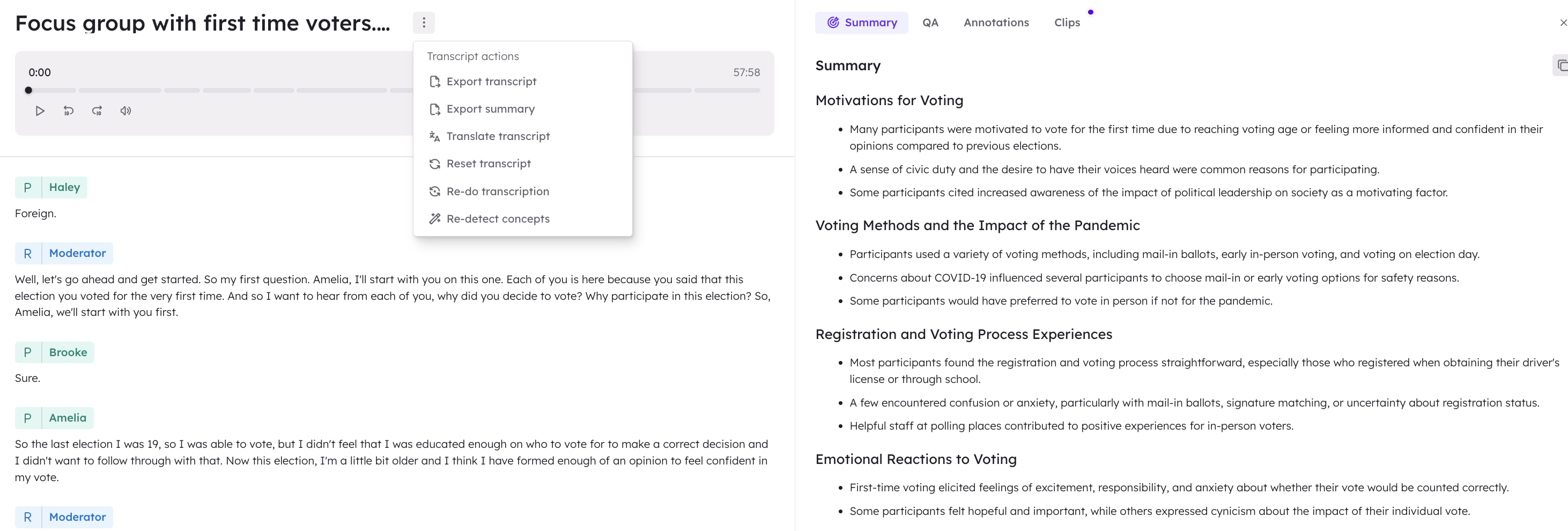 To export several files at once, select them in Files, open Actions at the top of the file list (or press ⌘K, Ctrl+K on Windows) and choose Export transcripts. The zip contains every language for every file you selected, each document named with its language code.
Playing back audio or video
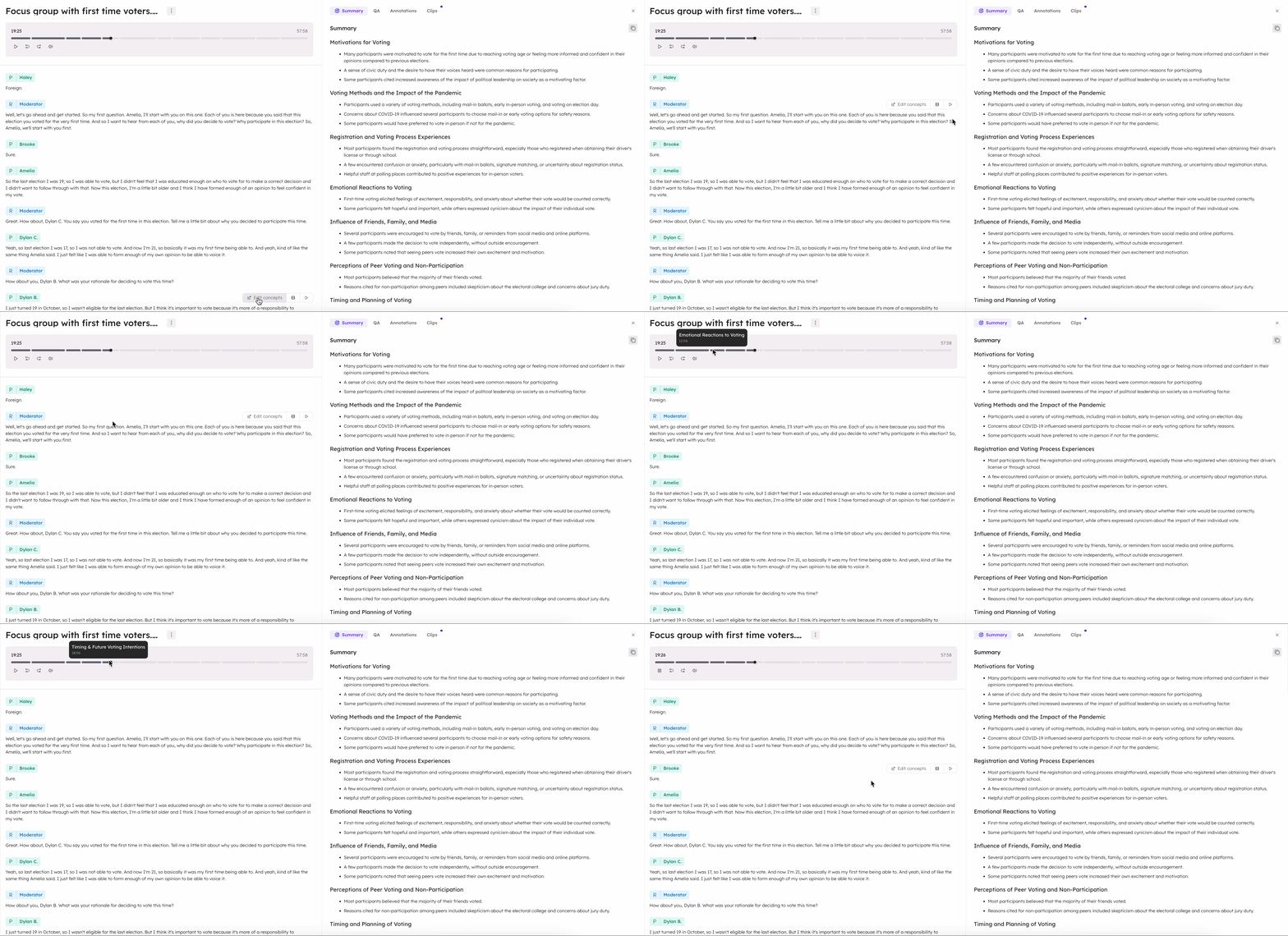
Mouse over the right hand side of the text segment to play back the audio or video. The scrub bar of the audio or video file is broken down into overarching discussion topics. You can also press any point along the bar to play back the file. Scrolling through the transcript will partially collapse videos to increase visibility of the transcript.